Qin Guan and Moon as Bright​ as Water

Guest Post from James Dissette at Chester River Press

I first saw the Qin Guan manuscript in 1986 shortly after I printed my first book, David Young’s remarkable translation of Pablo Neruda’s masterpiece, The Heights of Macchu Picchu. At that time, David had been working with William McNaughton to translate the Chinese poet, and our plan was to publish a limited edition through my first press, Songs Before Zero. I loved the seventeen poems, their condensation, their sharp emotional centers, their sense of exile and lost love, and saw the book clearly in my mind as beautiful and a significant addition to the canon of Chinese literature.

I don’t recall the literary ambiance of the small press resurgence in the late 80s. Everyone was off on their own path, as it should be. Exciting titles were coming out of Copper Canyon, and Greywolf and valuable trade book translations of European poets were arriving from Oberlin’s Field translation series under David’s editorship. Somewhere in the background, Rexroth’s 100 Poems from the Chinese wove in and out of my life, Gary Snyder’s enriching forays into Chinese translation, and Pound of course, but I had no firm intention to set out on a course of publishing poetry in translation. Instead, I was writing to W.S. Merwin who graciously offered the possibility of a limited edition of The Miner’s Pale Children, and at the same time trying to snag Greg Corso during one of his sojourns through Bandon, Oregon.

Then Qin Guan (Chin Kuan) came along as a complete surprise (and it still is 30-some years later), so I cleared my desk, talked with Harold Berliner about monotype fonts (I’d used his Lutetia for The Heights of Macchu Picchu) and Twin Rocker about paper.

But life does not orchestrate around one’s desires. Back to back family tragedies, a divorce and loss of my press forced me into commercial graphic design as the smell of ink on the press grew faint in my memory, but not my longing for it.

Sixteen years later I moved back east to Chestertown, Maryland where I’d gone to Washington College, and which had over the years developed an active letterpress shop under the expertise and care of Mike Kaylor who has dedicated much of his life to teaching students the magic of the printing arts. I was invited as a “guest printer” to print John Barth’s  monograph Browsing and was swept entirely back into the craft I’d missed for so long. But…I was up against a strict deadline—I was moving to Michigan and needed to finish the book. Unfortunately, the Vandercook I was using broke and required work I could not accomplish in time for me to finish. Thinking I might complete the last few pages somewhere near me in Michigan, either through begging or payment, I discovered Chad Pastotnik and Deep Wood Press. Chad, in his always gracious style, saved my ass and invited me to complete the book at his press. More importantly, he and I became fast friends and established a partnership that produced the Chesapeake Voyages of Capt. John Smith (sold out in 3 months), and Conrad’s Heart of Darkness which gleaned the Carl Hertzog Award for Excellence in Book Design. While the press imprint reads Chester River Press, CRP exists as our collaborative effort separate from his own inimitable and gorgeous book production.  More than that, we have fun and work intuitively together on the projects. If you’ve ever worked with another in a small press-room you quickly adjust to a kind of slow dance  to stay out of each other’s way but within arm’s length of any needed assistance. Either it works, or becomes awkward and counter-productive. Designing a book together requires a similar flow of creative movement. It only takes the raising of an eyebrow, a pause in the phone conversation, a smirk, to read the signals from each other.

I showed Chad the Guan mss. sometime around 2007. I’d been haunted by it for 20 years and still hoped that somewhere along the line the project could be revisited. But surely in all this time it had been printed? Additionally, I was a bit ashamed for not having  been in touch with David Young for so long. I bit the bullet and contacted David regarding getting in touch with Franz Wright who had ben a student of his at Oberlin and he told me that although William McNaughton had since passed away the manuscript remained unpublished. So began round two of publishing Moon As Bright As Water and another deep dive into the art of translation, and the wonders this significant manuscript offers.

Next: About Qin
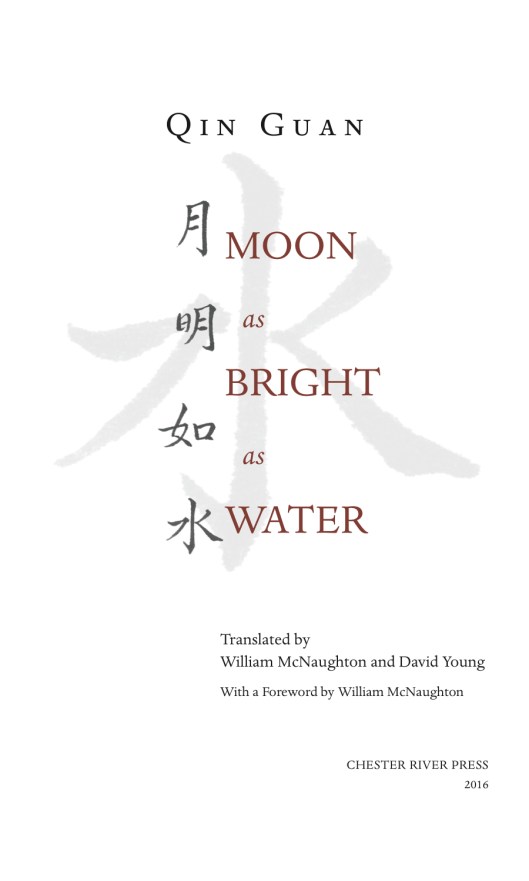
Moon as Bright as Water by Qin Guan

Tags

, , , , , ,

The Hunter Gracchus is currently undergoing a major redesign. I was unhappy with the format and size of the book so have undertaken a new approach which includes a larger folio size, heavier paper stock to better accommodate the intaglio prints and new layout for the text.

So in the interim:


MoonTitle

I am pleased to announce the impending publication of Moon As Bright As Water: Seventeen Poems by Qin Guan under the imprint Chester River Press that I share with my partner James Dissette.

Translated by William McNaughton, former chair at Hong Kong University, and poet David Young at Oberlin College, these poems showcase Qin Guan, a relatively unknown 11th -century master of Chinese verse whose company could include the likes of the esteemed Li Po (Li Bai) and Du Fu. Praised by the illustrious Wang An-shih, Guan was a disciple of Su Shih (Su Dongpo) one of China’s masters of multiple literary forms, and who strived to loosen the poetic conventions of the day.

As an acolyte would, Qin Guan blew out the conventional even more by writing about his encounters with courtesans, a subject considered to be a major indiscretion by Chinese society in Keifing. He wrote is a style called t’zu, a lyrical form that McNaughton likens to “cabaret songs” or “words to music” often chosen by the courtesans to sing during their professional entertainments.

Quong lived a tumultuous life during the Northern Sung Dynasty (A.D. 960-1127) Political clashes led to a string of banishments and exiles, his poetry was shunned for its sensuality, and he suffered from the vicissitudes of love—all of which moved him to write these brief, incandescent poems of departure and “long goodbyes.”

A streak of his poetic melancholy and gift for imagery appears in the poem “Eight Six”:

the pleasures of love run off

with the flowing streams…

the sound of the white silk string breaks off

and the stick of incense — kingfisher green —

burns up

This limited edition of Qin Guan’s poetry eschews the temptation to use ornament. Instead, Dissette and Pastotnik serve Guan’s voice by offering it an open, breathing page without distraction with the feeling that the poet’s imagery is enough to engage us.

The text is set in Dante and printed in two colors on Hahnemühle Biblio paper, 8×10.5 inch page format. Cover treatments are still being worked out but the edition is set at 100 books with 10 deluxe copies and 5 sets of folios reserved for hand binders. Printed by Chad Pastotnik at Deep Wood Press and hand bound in his studio.

The book is designed by James Dissette and Chad Pastotnik, whose collaboration in the past included John Barth’s Browsing, The Chesapeake Voyages of Capt. John Smith and are Hertzog Award recipients for Joseph Conrad’s Heart of Darkness.


William McNaughton (1933-2008) studied with Ezra Pound 1953-1956 and established the Chinese language programs at Oberlin College, Wabash College, Antioch College Denison University and Bowling Green State University. He was the founding Program Director of the University of Hong Kong’s BA Translation and Interpretation program where he worked until his retirement in 1998. He has written ten books on Chinese language, Asian literature and Russian literature.

David Young has been Longman Professor of English at Oberlin College since 1986 and an editor of FIELD magazine since 1969.  He is the author of several collections of poetry, including Field of Light and Shadow (Knopf, 2010); Black Lab (2006); At the White Window (2000); Night Thoughts and Henry Vaughan (1994), which won the Ohio State University Press/The Journal Award in Poetry; The Planet on the Desk: Selected and New Poems 1960-1990 (1991); Foraging (1986); Earthshine (1988); The Names of a Hare in English (1979); Work Lights: Thirty-Two Prose Poems(1977); and Boxcars (1972). His translations include Out on the Autumn River: Selected Poems by Du Mu (2006) and Clouds Float North: The Complete Poems of Yu Xuanji(1998), both with Jiann I. Lin; Selected Poems by Eugenio Montale(2004), with Charles Wright and Jonathan Galassi); The Poetry of Petrarch (2004); The Book of Fresh Beginnings: Selected Poems of Rainer Maria Rilke (1994), Miroslav Holub’s Vanishing Lung Syndrome and The Dimension of the Present Moment (both 1990),Five T’ang Poets (1990), Pablo Neruda‘s The Heights of Macchu Picchu (1987), and Rilke’s Duino Elegies (1980).

Moon As Bright As Water was edited by Richard Kent, Professor of East Asian Art History at Franklin Marshall College. He received his B.A. in English from Oberlin College and his M.A. and Ph.D. in Chinese art and archaeology from Princeton University.