The Hunter Gracchus is currently undergoing a major redesign. I was unhappy with the format and size of the book so have undertaken a new approach which includes a larger folio size, heavier paper stock to better accommodate the intaglio prints and new layout for the text.
So in the interim:
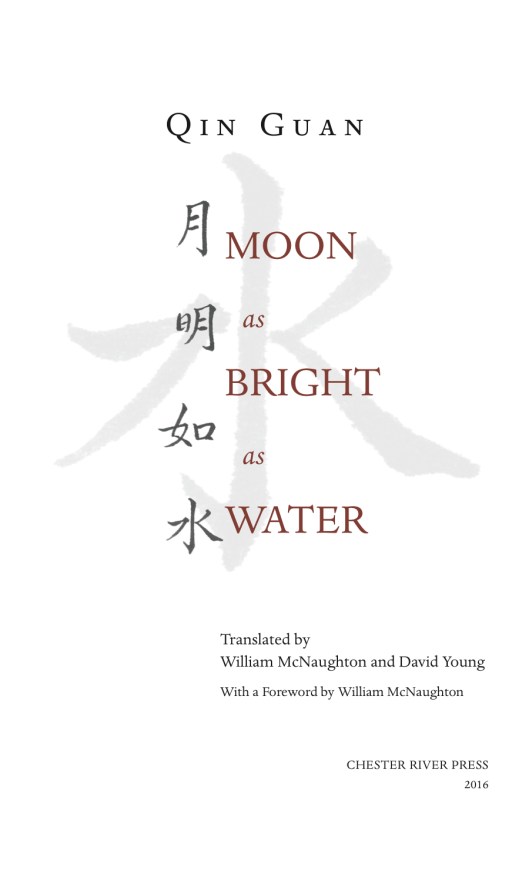
I am pleased to announce the impending publication of Moon As Bright As Water: Seventeen Poems by Qin Guan under the imprint Chester River Press that I share with my partner James Dissette.
Translated by William McNaughton, former chair at Hong Kong University, and poet David Young at Oberlin College, these poems showcase Qin Guan, a relatively unknown 11th -century master of Chinese verse whose company could include the likes of the esteemed Li Po (Li Bai) and Du Fu. Praised by the illustrious Wang An-shih, Guan was a disciple of Su Shih (Su Dongpo) one of China’s masters of multiple literary forms, and who strived to loosen the poetic conventions of the day.
As an acolyte would, Qin Guan blew out the conventional even more by writing about his encounters with courtesans, a subject considered to be a major indiscretion by Chinese society in Keifing. He wrote is a style called t’zu, a lyrical form that McNaughton likens to “cabaret songs” or “words to music” often chosen by the courtesans to sing during their professional entertainments.
Quong lived a tumultuous life during the Northern Sung Dynasty (A.D. 960-1127) Political clashes led to a string of banishments and exiles, his poetry was shunned for its sensuality, and he suffered from the vicissitudes of love—all of which moved him to write these brief, incandescent poems of departure and “long goodbyes.”
A streak of his poetic melancholy and gift for imagery appears in the poem “Eight Six”:
the pleasures of love run off
with the flowing streams…
the sound of the white silk string breaks off
and the stick of incense — kingfisher green —
burns up
This limited edition of Qin Guan’s poetry eschews the temptation to use ornament. Instead, Dissette and Pastotnik serve Guan’s voice by offering it an open, breathing page without distraction with the feeling that the poet’s imagery is enough to engage us.
The text is set in Dante and printed in two colors on Hahnemühle Biblio paper, 8×10.5 inch page format. Cover treatments are still being worked out but the edition is set at 100 books with 10 deluxe copies and 5 sets of folios reserved for hand binders. Printed by Chad Pastotnik at Deep Wood Press and hand bound in his studio.
The book is designed by James Dissette and Chad Pastotnik, whose collaboration in the past included John Barth’s Browsing, The Chesapeake Voyages of Capt. John Smith and are Hertzog Award recipients for Joseph Conrad’s Heart of Darkness.
William McNaughton (1933-2008) studied with Ezra Pound 1953-1956 and established the Chinese language programs at Oberlin College, Wabash College, Antioch College Denison University and Bowling Green State University. He was the founding Program Director of the University of Hong Kong’s BA Translation and Interpretation program where he worked until his retirement in 1998. He has written ten books on Chinese language, Asian literature and Russian literature.
David Young has been Longman Professor of English at Oberlin College since 1986 and an editor of FIELD magazine since 1969. He is the author of several collections of poetry, including Field of Light and Shadow (Knopf, 2010); Black Lab (2006); At the White Window (2000); Night Thoughts and Henry Vaughan (1994), which won the Ohio State University Press/The Journal Award in Poetry; The Planet on the Desk: Selected and New Poems 1960-1990 (1991); Foraging (1986); Earthshine (1988); The Names of a Hare in English (1979); Work Lights: Thirty-Two Prose Poems(1977); and Boxcars (1972). His translations include Out on the Autumn River: Selected Poems by Du Mu (2006) and Clouds Float North: The Complete Poems of Yu Xuanji(1998), both with Jiann I. Lin; Selected Poems by Eugenio Montale(2004), with Charles Wright and Jonathan Galassi); The Poetry of Petrarch (2004); The Book of Fresh Beginnings: Selected Poems of Rainer Maria Rilke (1994), Miroslav Holub’s Vanishing Lung Syndrome and The Dimension of the Present Moment (both 1990),Five T’ang Poets (1990), Pablo Neruda‘s The Heights of Macchu Picchu (1987), and Rilke’s Duino Elegies (1980).
Moon As Bright As Water was edited by Richard Kent, Professor of East Asian Art History at Franklin Marshall College. He received his B.A. in English from Oberlin College and his M.A. and Ph.D. in Chinese art and archaeology from Princeton University.


